Ainswick
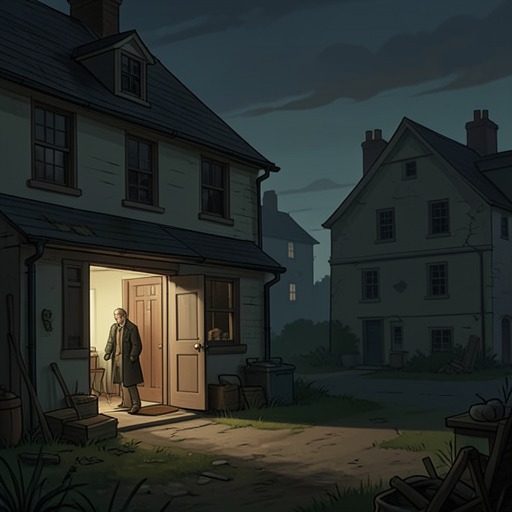
The HollowAinswick is the Angkatell family estate, a large white country house reached through woods and an open approach, and one of the novel’s central spaces of memory. It is associated with childhood happiness, inherited property, Edward Angkatell’s solitary life, and the unrealized possibility of Henrietta Savernake’s return. More than a background location, Ainswick acts as a repository of family history: its beauty draws characters toward an imagined peace, while its inheritance structure and emotional claims reveal how strongly the past governs the present.
Setting and Family Inheritance
Midge Hardcastle remembers Ainswick through a sequence of concrete arrivals: the small country station where the London express stopped after notice had been given to the guard, the waiting Daimler, the drive through the woods, and the final turn through the gates into the open view of the big, white, welcoming house. The estate is inseparable from Old Uncle Geoffrey, whose patchwork tweed coat and greeting to the visiting children belong to the place’s remembered warmth. In Midge’s recollection, Ainswick is not merely a house but an entire country of anticipation, arrival, trees, family voices, and temporary release from the grimness of her industrial northern home.
The estate’s ownership also embodies the Angkatell family’s complicated inheritance system. Old Geoffrey Angkatell’s only child was Lucy Angkatell, but the property could not pass to her because she was a woman. Henry Angkatell, her husband, was only a second cousin and therefore not as near in the succession as Edward. Ainswick consequently passed to Edward, Lucy’s cousin once removed and more than twenty years younger than her. Although Geoffrey had possessed considerable wealth, most of it had come to Lucy, leaving Edward comparatively poor: he had enough to maintain Ainswick, but little beyond that. The beautiful estate thus carries a material burden as well as a symbolic inheritance.
Edward had served for a time in the diplomatic service, but he resigned when he inherited Ainswick and came to live on the property. His life there is solitary and inward-looking. He is bookish, collects first editions, and writes occasional hesitant, ironic articles for obscure reviews. The estate accommodates this withdrawn intellectual life, but it also confines Edward within an inheritance he has accepted without possessing the wealth or social ease that once sustained it.
Ainswick in Childhood Memory
For Midge, Ainswick is centered above all on Edward. She remembers him as tall, gentle, diffident, and kind, while she herself came to the estate from the North Country and Henrietta arrived from Ireland. The visits were anticipated for months; Midge lay awake for nights beforehand, imagining the journey and the moment of arrival. Yet her happiness was shadowed by the fact that Edward scarcely noticed her because Henrietta was there. Ainswick therefore preserves both the radiance of childhood and the first shape of Midge’s emotional exclusion.
Henrietta’s memories are equally intense but more elegiac. When Edward asks whether Ainswick is still the same or has changed, she imagines it as unchanged. She remembers herself as a long-legged girl with untidy brown hair, happy without knowing what life would do to her, and as a girl who loved trees. Her retrospective grief lies in recognizing that she had once been happy without understanding the value of that happiness. Ainswick becomes the place to which she mentally returns precisely because actual return is impossible.
Henrietta calls Ainswick the loveliest place in the world. Edward’s response is practical and emotionally charged: he suggests that she could be peaceful and happy there, even if she had to put up with him, and asks her to come and make it her home. His proposal treats the estate as a refuge that has always been waiting for her. Yet Henrietta refuses the temporal fantasy behind it. She insists that one cannot go back, and Edward identifies the decisive obstacle: she will not marry him because of John Christow. Ainswick can offer continuity, but it cannot erase the life Henrietta has already chosen and the attachment that binds her to John.
Edward, Henrietta, and the Unfulfilled Home
Ainswick is the material form of Edward’s repeated hope for Henrietta Savernake. He has asked her three times to marry him, and each proposal is connected to the possibility that she might share his life on the estate. His invitation is not simply a romantic gesture; it offers her a fixed home, a settled identity, and an escape from the turbulence surrounding John Christow. The estate appears to promise peace because Edward imagines it as a place outside the destructive pressures of the present.
Henrietta’s refusal exposes the limits of that promise. She does not deny Ainswick’s beauty; indeed, her reverence for it is part of what makes the refusal painful. The estate survives in memory as something nearly perfect, but Henrietta understands that returning to it would not restore the girl who once loved its trees. Edward can inherit the house, maintain it, and invite her into it, but he cannot recreate the vanished emotional conditions of childhood. Ainswick is therefore the setting of an uncompleted relationship: it offers a future that resembles the past, while Henrietta recognizes that neither can be recovered.
The Estate After John Christow’s Death
Lucy Angkatell’s anxiety about Ainswick reveals that the estate is also the imagined future of the family line. She worries that Edward and David Angkatell are the last of the Angkatells. David, she believes, will never marry because of his mother, and when Edward dies David will inherit Ainswick without producing a successor. Lucy foresees the extinction of the Angkatell name and the disappearance of the family world embodied by the estate. Her concern turns Ainswick from a private residence into a threatened dynastic structure.
After John Christow’s death, Ainswick remains present even when the action is centered elsewhere. Henrietta thinks of herself and Edward as a linked pair, but John’s death has not removed him from their world. Though he has been buried and the burial service has been read, she feels that he has not been buried deeply enough: John is still present at The Hollow. Against this continuing presence, Ainswick represents Edward’s hoped-for alternative, a place where life might be reorganized around Edward and Henrietta. The contrast is telling: the estate promises an orderly future, but memory and grief continually carry the dead into it.
Narrative Significance
Ainswick functions as a counter-image to The Hollow. The Hollow is the immediate site of the crime, performance, concealment, and collective response; Ainswick belongs to an older world of family continuity, childhood recollection, and inherited order. Yet the two spaces are connected by the same inability to escape the past. At The Hollow, old relationships return as motives and suspicions. At Ainswick, the past appears as beauty and refuge, but its inheritance rules, extinct hopes, and absent people make that refuge unstable.
The estate also gives physical form to the novel’s treatment of memory. Midge’s recollection of the station, Daimler, woods, house, and family gatherings is vivid because Ainswick has become larger than an ordinary place in her inner life. Henrietta’s longing for its unchanged loveliness similarly turns it into an imagined sanctuary. Edward lives in the actual estate, but even he uses it as a promise of emotional restoration. Ainswick is thus both a real inherited property and a mental landscape repeatedly revised by those who remember it.
Its decisive significance lies in the tension between permanence and irreversibility. Ainswick seems to wait unchanged, yet the people who once made it feel like heaven have grown older, died, separated, or chosen other lives. The estate can be inherited and preserved, but childhood cannot be repeated, Henrietta cannot simply return, and the family future remains threatened. Ainswick endures as architecture, property, and memory, while the human world that gave it meaning continues to pass away.